
Why Woven Stainless Screens Tear — and Why It Is Not a Wear Problem
A screen that wears out is an inconvenience. A screen that tears is a shutdown. Those are different failures with different causes, and only one of them can be scheduled around.
This page is about the second one: why the wire in a woven stainless screen cracks at loads nowhere near what the material can take, what the published research says is happening inside it, and whether anything can be done about it.
A Torn Screen Is Not a Consumable, It Is a Shutdown
Most consumable parts in a plant degrade in a way you can see coming. An edge dulls. A surface polishes. A clearance opens up. You schedule around it, and the cost lands in a budget line where it belongs.
A woven wire screen does not behave that way. It runs, and runs, and then one wire lets go. After that the tear propagates quickly, oversize product goes where it should not, and somebody is pulling a deck apart on a shift that was supposed to be production.
The cost is not the screen. It is the hour nobody planned for, the product that has to be held and checked, and the paperwork that follows a stream that was supposed to be screened and was not.
So the useful question is not how to make the screen last longer. It is why the wire cracks at all.
The Screen Is Not Made of the Alloy on the Certificate
Your screen is specified as 304 or 316 stainless. That is true of the steel that left the mill. It is not a complete description of the wire in your deck.
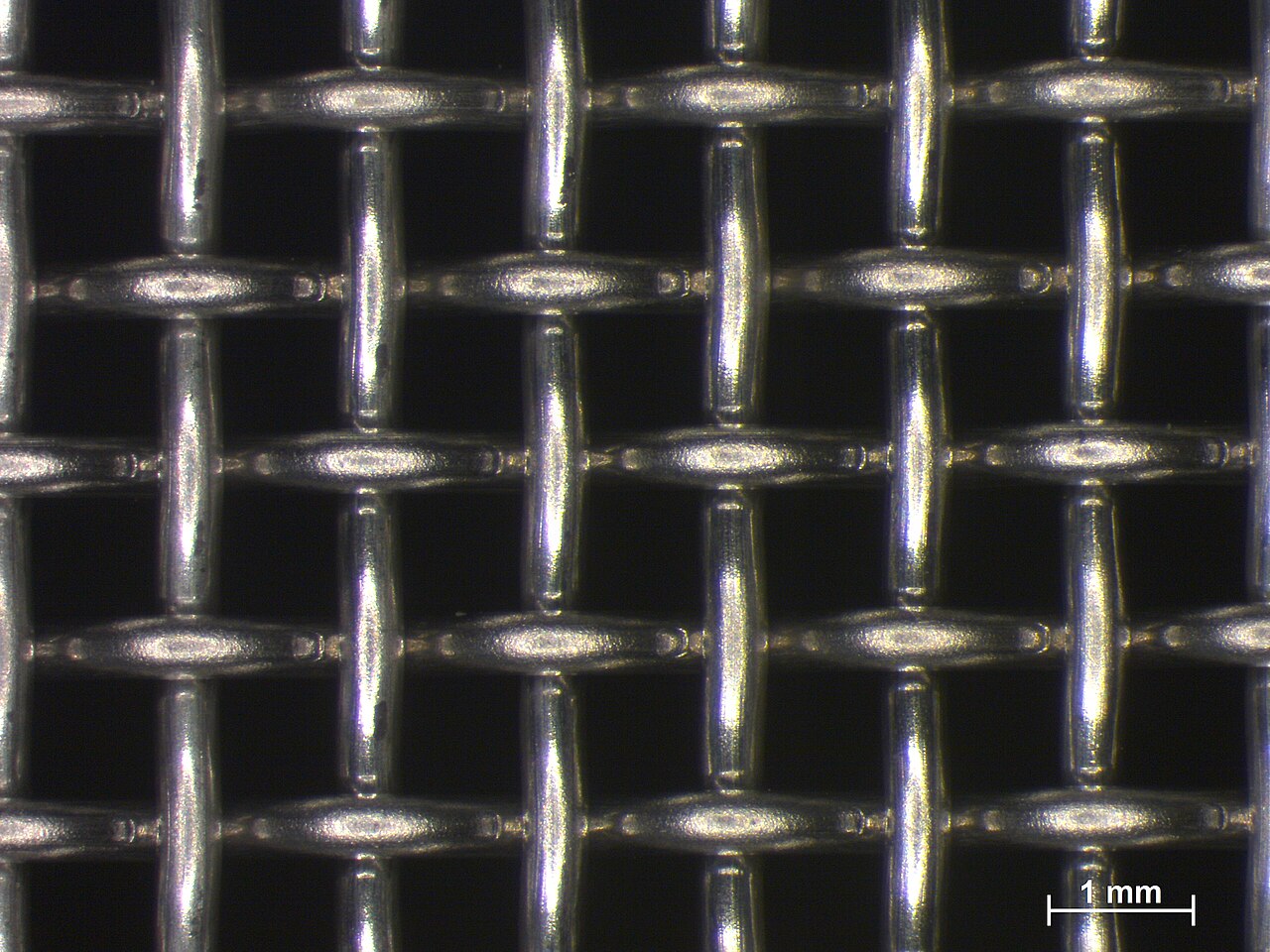
To become wire, that steel was pulled through a series of dies — not one, but dozens of passes, each reducing the diameter a little further. Metallurgists class wire drawing as severe plastic deformation, and it changes the material profoundly.
A 2026 study at Nanjing Tech University measured what that does to 304. Yield strength rose from 320 MPa to about 2 GPa — roughly six times stronger than the annealed steel it started as. The strengthening comes from a phase change: drawing converts austenite into martensite progressively, and the strength of the wire tracks almost linearly with how much martensite has formed.
That is worth reading twice, because everything below depends on it. The wire in a 304 screen is not fully austenitic any more. It is a heavily cold-worked, substantially martensitic material that happens to have started life as 304.
What the Dies Leave Behind
Strength is not the only thing drawing adds. It also leaves stress.
A 2024 study by the Fraunhofer Institute for Machine Tools and Forming Technology, with the Karlsruhe Institute of Technology, examined exactly this on X5CrNi18-10 — material number 1.4301, which is 304. Their finding:
As a result of the elasto-plastic deformation during the wire drawing process, tensile residual stresses are generated near the surface in the axial and tangential direction, and balancing compressive residual stresses form in the core.
And then the sentence that matters to you:
These residual stress distributions can reduce the fatigue strength and fatigue life of the components.
Consider where that stress sits. Fatigue cracks start at surfaces — that is where the flaws are, where the geometry changes, and where stress concentrates. Drawing puts a tensile residual stress in precisely that layer.
The practical meaning is uncomfortable. The wire in your screen is already being pulled apart at its surface before it has sieved a single kilogram. Every service cycle adds to a load that was there on day one. The screen is not starting from zero; it is starting from a head start the crack was handed at the wire mill.
The same paper notes that the transformation to martensite concentrates in that near-surface region too, because that is where shear from the die is highest. The surface of the wire is the most heavily worked, the most transformed and the most stressed part of it — and it is the part that cracks.
Why “Austenitic Stainless Does Not Respond” Is the Wrong Objection Here
If you have looked into cryogenic treatment before, you may have been told — possibly by us — that austenitic stainless is the weak case. That is a fair summary of the published work on annealed austenitic material. Our own page on which stainless grades respond to cryogenic treatment says so, and publishes a study in which 316L showed no measurable change at all.
We are not walking that back. But it does not describe drawn wire.
The reasons that null result exists are that annealed austenitic steel has no martensite transformation left to complete, little retained stress to relieve, and a stable structure that a cold soak has limited purchase on. A drawn screen wire is the opposite on all three counts. It is heavily cold-worked, substantially martensitic at the surface, and carrying a tensile residual stress that is actively working against it.
The grade on the certificate is not the description of the material. That is the same point we make about 3D-printed stainless, which also behaves nothing like wrought bar of the same designation.
What the Research Says About Cold-Drawn Wire
There is no published study of cryogenically treated woven screens — we have looked. What the literature does cover is cold-drawn wire under cyclic load, which is the duty a screen performs, and that work is directly relevant.
- Compression springs are cold-drawn wire flexed millions of times. In a study of chrome silicon steel springs, cryogenic treatment increased the compressive residual stress at the wire surface, and fatigue life rose with it. That is the surface stress moving in the favourable direction — the exact quantity the Fraunhofer work identifies as governing fatigue.
- AISI 304 specifically: in work on ground 304 components, a cryogenic surface treatment improved the endurance limit at two million cycles by 72% against the ground condition, again attributed to higher compressive residual stress. A different process from ours, but the same material and the same mechanism, moving the same way.
- 51CrV4 spring steel given a cryogenic step before tempering showed significantly higher tension-tension fatigue life than conventional quench and temper.
None of that is a screen. All of it is the same argument: in cold-worked wire that fails by fatigue, surface residual stress governs the life, and cryogenic processing moves that quantity in the right direction.
That is a reason to run a trial. It is not a number to put in a budget, and anyone who hands you one for your screens is guessing.
What a Maintenance Planner Actually Needs to Know
The metallurgy is rarely what stops this. What stops it is that a treated part is a new variable in a system somebody is accountable for. So, directly:
Does it change the screen dimensionally?
No. It is a through-treatment at low temperature, not a coating and not a heat treatment. There is no scaling, no oxide and no distortion from heat. Screens come back the size they went out and tension the same way in the frame.
Does it add anything to the surface?
Nothing. No plating, no coating, no chemical. Nothing is deposited that could flake, wear through or need declaring on a food-contact basis. The material is the same alloy it was — it has been taken to a very low temperature and brought back slowly. In a food plant this is usually the question that matters most, and it is the easiest one to answer.
Will it change how the screen fails — will it tear without warning?
We have no evidence of a change in failure mode and would not expect one. The mechanism in the published work is a shift in residual stress, which delays crack initiation. It is a cold soak, not a hardening step, so it does not make the material brittle in service. That said, this is exactly what a trial should watch for, and we would rather you watched for it than took our word.
What changes in our PM routine?
Nothing, until you have data. That is the point of running treated and untreated screens side by side: you keep your existing interval and record what actually happens. Do not extend a replacement interval on the strength of an expectation. Extend it when your own numbers say you can.
How do we track a mixed fleet?
Mark the frames, not the mesh, and record the install date and deck position. Screens in different positions on the same machine do not see the same duty, so a treated screen on a hard deck compared against an untreated one on an easy deck will tell you nothing.
Who is accountable if the interval changes and it is wrong?
Nobody should be, because nobody should be changing an interval on this basis yet. A trial produces evidence, not a commitment. If the treated screens do not outlast the untreated ones, you have spent the cost of treating a handful of screens and learned something true about your plant.
How to Run a Trial That Produces an Answer
This is how any change to a consumable gets qualified, and most plants already have the habit. A few details decide whether the exercise produces a number you can act on or one you cannot.
- Treat a batch, not one screen. Single-screen comparisons are swamped by the normal spread in screen life. Half a dozen either way is the minimum that tells you anything.
- Same machine, same deck position, same product. Rotate positions if the decks on your machine see meaningfully different duty.
- Record tears, not hours. The number that matters is time or tonnage to first tear, and where the tear started.
- Keep the failed screens. A tear that begins at a weave crossover is a different story from one that begins mid-span, and it is worth knowing which you have.
- Let it run. Screens are long-lived. A trial that reports in a fortnight has not measured anything.
What We Can Show You
We have been treating parts that fail in service since 1980, from one plant in Torrance, California. The failure described on this page — a crack starting at a surface under cyclic load — is not unfamiliar ground. It is most of the work. Springs, bearings, drivetrain components, cutting tools and dies fail that way, and they are what fills the processors most weeks.
A woven screen is a different part. It is not a different problem.
On screens specifically, an equipment manufacturer approached us at a trade show, sent us stainless screen samples, and evaluated them in their own laboratory. The result came back in our favour. We are not publishing their figure here, because the test was theirs and the data is not ours to release. When we have their agreement it will appear on this page with the source named.
That situation is worth understanding before you judge any supplier by what is on their website. Most customer results never get published. A plant that measures a real gain has usually spent money proving it, and its legal department has little interest in that number appearing in a vendor's marketing. The results we are permitted to publish are the exceptions, collected in one place.
So this page argues from published research rather than from our own figures. All of it is open access and linked below, which means you can check every number in it without taking anything on trust from us.
What that research establishes is straightforward: the failure you are seeing is a fatigue failure; the tensile surface residual stress left by wire drawing is a published cause of reduced fatigue life in your exact material; and in cold-drawn wire under cyclic load, cryogenic treatment moves that stress in the favourable direction.
Settling it for your own plant is the same exercise as qualifying any other change: treat a batch, run it beside what you are using now, and count. We will tell you what the numbers say either way.
Frequently Asked Questions
Why do sifting screens tear instead of wearing out?
Because the dominant load is cyclic rather than abrasive. The mesh flexes with every stroke of the machine, and a crack initiates at a wire surface and propagates. Abrasion from the product matters in some applications, but a tear is a fatigue event.
Does cryogenic treatment work on 304 stainless?
On annealed 304 bar the published evidence is mixed, and we say so. Drawn 304 wire is a different material — heavily cold-worked, substantially martensitic at the surface, and carrying tensile residual stress. The reasons annealed material responds poorly do not apply to it.
Will it make the screen more corrosion resistant?
Do not buy it for that. The published evidence on corrosion is inconsistent, and the one study that measured an improvement on stainless called its own result marginal.
Does the screen need to be re-tensioned or re-qualified?
It comes back dimensionally as it went out, so it tensions as before. Whether your own quality system requires re-qualification of a treated part is a question for your system, not for us.
Can you treat a screen that is already in service?
The process does not care whether a part is new or used, provided it is clean, and we have treated used parts of every other description since 1980. A screen that has already cracked is a different matter: the treatment will not close an existing crack, and a cracked screen should be scrapped rather than treated.
How cold, and for how long?
Production cycles hold between −308 °F and −312 °F, close to liquid nitrogen's own boiling point. Parts go down on a controlled ramp, soak, and come back slowly. The ramp matters as much as the temperature — this is not a matter of putting parts in a freezer.
Sources
- Yu, Y., Fu, W., Dai, F., Li, R., Lai, Q. (2026). Martensitic Transformation and Strengthening Mechanism in a 304 Stainless Steel Subjected to Wire Drawing. Materials, 19(11), 2412. Nanjing Tech University. DOI 10.3390/ma19112412. Source of the 320 MPa to 2 GPa figures and the transformation pathway.
- Selbmann, R., Gibmeier, J., Simon, N., Kräusel, V., Bergmann, M. (2024). Residual Stress Engineering for Wire Drawing of Austenitic Stainless Steel X5CrNi18-10 by Variation in Die Geometries — Effect of Drawing Speed and Process Temperature. Materials, 17(5), 1174. Fraunhofer IWU and Karlsruhe Institute of Technology. DOI 10.3390/ma17051174. Source of both quotations above.
Both are open access in full, so the numbers above can be checked rather than taken from us. Laboratory results on test coupons are not a prediction for your screens — they are the reason to run a trial, not a substitute for one.
Send Us a Batch of Screens
If your screens are tearing rather than wearing, the way to find out whether this helps is to treat a batch and run them beside the ones you have. We will tell you what we find either way.