
How a Bad Regrind Shortens the Next Interval
Every tool room has a tool that keeps coming back faster. It went 80,000 hits, then 60,000, then 45,000, and nobody changed the job. The usual assumption is that the tool is simply wearing out.
Sometimes it is. Often, the damage is being done at the grinder.
What Actually Happens During a Regrind
Grinding is a cutting operation, and like any cutting operation it puts heat into the workpiece. The difference is where that heat goes. A grinding wheel has thousands of tiny, negatively-raked cutting edges running at high speed across a small contact area. Most of the energy ends up as heat, and most of that heat goes into the part rather than the chip.
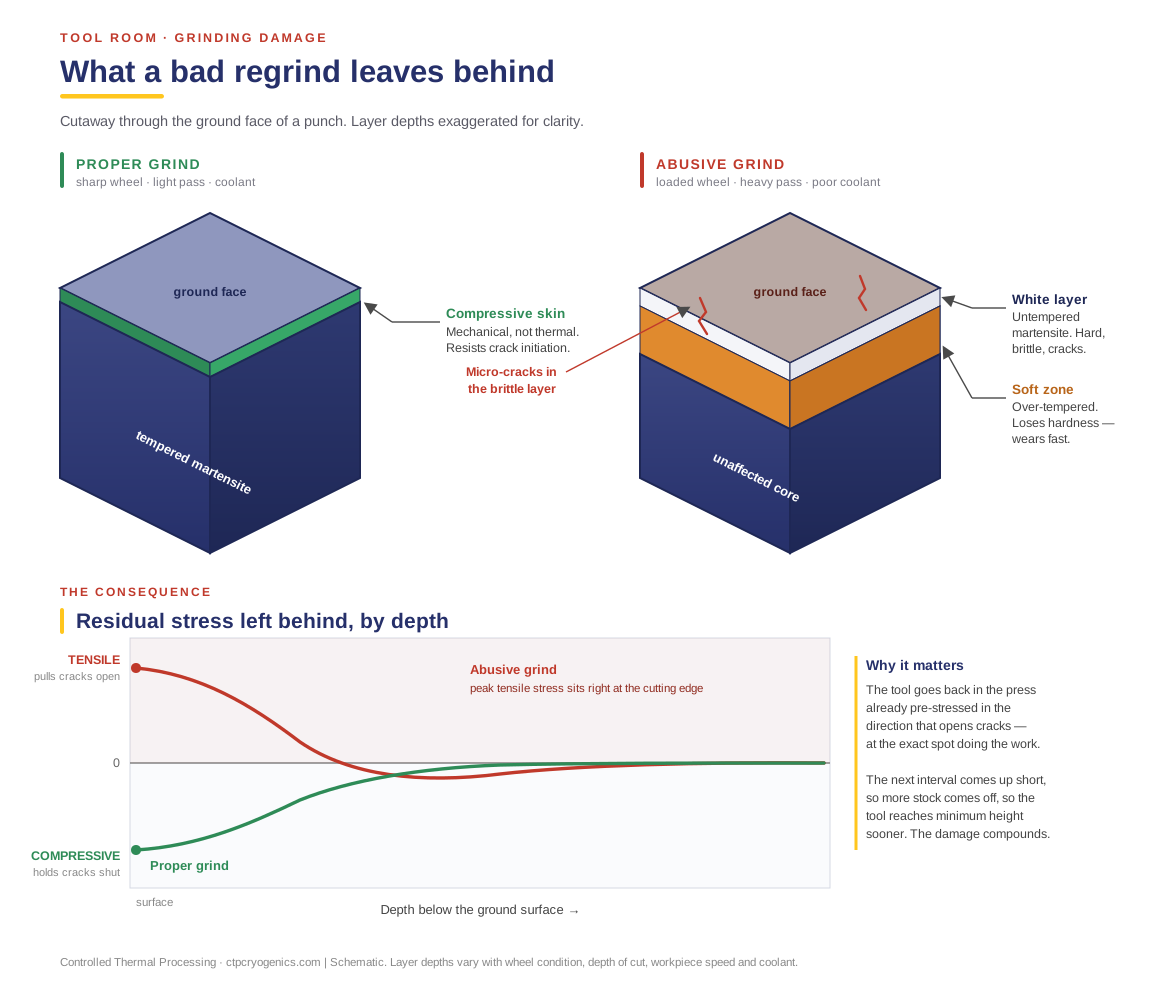
Under controlled conditions — a dressed wheel, a light pass, adequate coolant — that is fine. The surface stays cool enough that nothing changes metallurgically, and the mechanical action of the grit actually leaves the surface in compressive residual stress, which is a good thing. Compressive stress at the surface resists crack initiation.
Push any of those three variables and the picture reverses.
→ Interval getting shorter for another reason? — clearance, alignment, lubrication and grade are the four to rule out before the grinder.
The Three Kinds of Damage, in Order of Severity
Tensile residual stress
The first thing to go, and the hardest to see, because there is often nothing to look at. As the grinding zone heats and then the surrounding cold metal pulls it back, the surface is left in tension rather than compression. The tool goes back in the press pre-loaded in the direction that opens cracks, at precisely the location doing the work.
This is the mechanism that explains the tool coming back short with no visible burn and no obvious cause.
The over-tempered soft zone
Push further and the surface gets hot enough to temper the steel locally — beyond the temper it was given at heat treat. That region loses hardness. It is now the softest material on the tool and it sits exactly where the wear is happening, so it disappears quickly, and the next interval is shorter again.
The white layer
Push further still, past the austenitizing temperature, and the surface re-hardens as the coolant quenches it. What forms is a thin layer of untempered martensite — extremely hard, extremely brittle, and sitting on top of the over-tempered soft zone underneath. Metallurgists call it white layer because of how it appears under the microscope after etching.
Brittle material on a soft base, at a cutting edge, under impact. It cracks, and the cracks run down into the softer layer beneath.
How to Tell If This Is Happening to You
- Discoloration on the ground surface. Straw, blue or brown tint after grinding means you put temper colors into the steel. If you can see color, the damage is already well past the invisible stage.
- Fine cracks, often in a network. Sometimes only visible after etching or under magnification, frequently running perpendicular to the grinding direction.
- Edge flaking early in the run. A freshly sharpened tool that chips microscopically in the first few thousand hits is a brittle-surface tell, not a wear problem.
- The interval getting shorter with each regrind, with no change to material, clearance or press. This is the pattern that should send you to the grinder rather than to the tool supplier.
Grinding So It Does Not Happen
None of this is exotic. Most of it is ordinary tool-room practice and costs nothing to adopt.
- Sharpen earlier than you think. A common rule of thumb is to regrind at around .010″ of edge wear rather than running until the tool is visibly failing — check the figure your own tooling supplier gives for the tools you run. A worn tool takes more tonnage, which generates more heat in the press as well as more damage to chase at the grinder. Frequent light touch-ups beat occasional heavy ones on every measure.
- Take .001″ to .002″ per pass, .005″ to .010″ total. Heavier passes are the single biggest driver of grinding-zone temperature.
- Never grind dry. Coolant is not optional on tool steel. Insufficient coolant is the most common cause of both cracking and local annealing.
- Dress the wheel. A loaded or glazed wheel stops cutting and starts rubbing, and rubbing is all heat and no material removal.
- Use a finer grit where you can. Finer grit tends to leave the surface in compressive stress; coarse aggressive grinding pushes it toward tensile.
- Hone a small radius after grinding. A true zero-radius edge flakes microscopically under load, and every flake leaves a site for the next one. A honed radius of .001″ to .002″ lasts longer than a theoretically perfect edge.
- Stop taking more stock than the damage requires. Every thousandth removed is life off the tool’s total. A tool scrapped at minimum height after five regrinds instead of eight has lost about a third of its potential life at the grinder, not in the press.
What This Costs You, in Numbers
Three effects compound:
- A damaged edge shortens the next interval, so you are back at the grinder sooner.
- Being back sooner means more tool changes, and every tool change is press downtime plus startup scrap.
- More regrinds, each taking more stock than necessary, means the tool reaches minimum height sooner and gets scrapped earlier.
The third one is the one nobody books. A die that should have lasted eight regrinds and lasted five did not fail in production — it was ground away.
We built a worksheet that puts numbers on this. Ten inputs off your own line, and it gives you the fully loaded cost per part, the press hours you lose per year to tool changes, and how much of that total is not the tool’s purchase price. No email required.
No macros, no scripts, no external links. If the file opens read-only behind a Protected View bar, that is normal for anything downloaded from the web — click Enable Editing and it works. The example figures in the sheet are placeholders, not CTP pricing — ask us for pricing on your own parts.
Where Cryogenic Treatment Fits, and Where It Does Not
Cryogenic treatment does not stop grinding damage. Grind a treated tool abusively and you will damage it the same way.
What we do see is that treated tooling tends to arrive for sharpening in better condition — less broken down at the edge, less material pulled out. Less damage to chase means less stock removed per regrind, and since tools are scrapped at minimum height, fewer thousandths each time means more regrinds available over the life of the tool.
Being clear about the strength of that claim:
Retained austenite transforms to martensite at cryogenic temperatures, with fine carbide precipitation following. Abusive grinding produces tensile residual stress and can form untempered martensite at the surface. Both are well documented.
Less stock removed per regrind on treated tooling, and more uniform hardness with fewer soft patches — which shows up as a better finish when the tool is ground. Consistent observations across customers over many years, not controlled trials.
Whether a tool with less retained austenite is less susceptible to grinding damage in the first place. Retained austenite is sometimes raised as a factor in white layer formation, which would make the mechanism plausible. We have not found it tested directly, and we are not going to claim it.
→ How often should you be sharpening punches and dies? — the five things that shorten an interval, and how to tell which one you have.
Related
- How often should you be sharpening punches and dies? — the five things that shorten an interval
- Why D2 punches and dies fail early — the four failure modes and how to tell them apart
- The cryogenic heat treatment process, step by step
- Cryogenic treatment vs. heat treating
- Micro-dimpling for galling and release problems
Our Guarantee
Log your current interval. Send us the tools. Run them against your own recorded number, on your own parts, and measure the result yourself.
If you cannot measure an improvement over your own baseline, we refund the treatment in full and cover the freight back to you.