
Produce More for Less — While Using the Tools You Already Run
Every manufacturer we can think of would like to reduce their operating costs. How do you do that without a major re-think in engineering? Deep cryogenic treatment changes the metal you are already running — no redesign, no new tooling, no change to the process around it.
This page is the map of where that pays on a plant floor: which components we have measured results for, which ones we have not, and where to read the detail. Tooling is not a fixed cost. It is a consumable, and the interval between replacements is the number that moves everything else.
What the Treatment Actually Does
A hardened part comes out of the quench with two problems: some of its structure never finished transforming, and the rapid cooling locked stress into it. Deep cryogenic treatment takes the part down near the boiling point of liquid nitrogen on a slow controlled ramp, holds it, and brings it back. Most of the leftover austenite converts to martensite, very fine carbides precipitate through the structure, and residual stress relaxes. A temper follows.
The result is a more uniform, more wear-resistant, more dimensionally stable part. It is a through-treatment, not a coating — it does not wear off, and it survives regrinding. The process, step by step walks through each stage, and cryogenic treatment vs. heat treating explains where it sits in the heat-treat cycle.
Where it does not help. It will not fix a wrong clearance, a worn die set, a misaligned press or a bad heat treat. If parts are failing by impact chipping rather than wear, a tougher grade is the answer, not a colder one. We would rather say that before you send us anything.
Where It Earns Its Keep, by Component
Each family below is labelled by the strength of the evidence behind it, because those are not the same thing and the industry usually blurs them.
Blades and knives
Granulator and pelletizer knives, seal blades, hot knives, slitters. Many of these run in stainless because the plant has no choice, and which stainless grades respond is the first question worth answering. The longest run of documented results we have, because plastics processors count blade changes closely.
- D2 granulator knives went from 3–4 weeks between sharpenings to 3–4 months, with stock removed per regrind down from .090″ to .040″ — regrind cost cut to a quarter, replacement knives to an eighth (New England Plastics, 2008).
- Granulator knives in crystal styrene ran nearly a year without resharpening, up from every four weeks (Comet Products, 1999).
- The Rubbermaid plant trial measured blade service life and the yearly cost per grinder.
Cutting tools: drills, mills and carbide
Where the failure mode is abrasive wear at the edge, this is the clearest case in the record.
- 3/32″ HSS drills through 316 stainless tubing: 1,025 holes treated against 123 untreated, same job, same drill (Danlyn Machine, 1998).
- M42 staggered-tooth cutters in stainless: 1,450 pieces per grind, up from 1,000. Cobalt cutters in an aerospace alloy: 100 per grind, up from 50 (National Automatic Products, 1999).
Punches, dies and broaches
Stamping and forming tooling, rotary dies, production broaches.
- A production broach ran 1,100 parts before its first regrind, up from about 300, then 2,200 more after that regrind (Saco Defense, 1984).
- A plant's worst-performing rotary die returned four times its previous life after treatment and sharpening; the plant moved all dies, new and old, onto the process (Kao Infosystems, 1990).
Why D2 punches and dies fail early · How often to sharpen · What a bad regrind costs you
Gears, drivetrain and hobs
Crown wheels, pinions, sprockets, and the hobs that cut them.
- Caterpillar scraper crown wheels had been losing single teeth for fifteen years. After treatment, one differential took a catastrophic diff-lock failure — broken lugs and pinion fragments ground through the gears — and the treated crown wheel did not lose a tooth, showing bruising in the root but no failure (crown wheel case study).
Molds, foundry tooling, welding electrodes, grinding wheels
Work we run regularly and have pages on, but where we have no customer-measured before-and-after figures we can publish. We would rather label it that way than borrow a number from a different application.
Plastic molds · Plastic molding · Foundry applications · Resistance welding electrodes · Grinding wheels · Electric resistance welding · Resistance spot welding
Bearings, hydraulics and other wear parts
Bearings, pump components, valve spools, cylinder rods, springs, chains, woven screens and wear plates all fail by mechanisms the treatment acts on — abrasive wear, fatigue, dimensional drift. The metallurgy supports it and the industry literature covers it, but we have not published a measured before-and-after on these families, so we are not going to claim one. If you run them and are willing to count, that is exactly the kind of trial we want.
How It Shows Up in OEE
Most plants already track the three factors. Tool life moves all of them, which is usually the easiest way to justify a trial to whoever signs for it.
Every tool change stops the machine. Longer intervals mean fewer changes, and fewer unplanned stops when an edge goes early.
Worn tooling gets nursed — feeds and speeds backed off to finish a run. Tools that hold their edge hold the rate.
Burrs, edge rollover and dimensional drift are what a worn tool produces before anyone changes it. That scrap is booked against quality, not tooling.
What OEE is and how it is calculated, if you need the definition to hand.
What a Longer Interval Is Worth on Your Line
Purchase price is the smallest part of what tooling costs. The regrind, the press or machine hours lost to every change, and the scrap run at startup are all tooling costs, and they are the ones nobody books that way. Our worksheet adds them up from ten numbers off your own line — no email wall, nothing to sign up for.
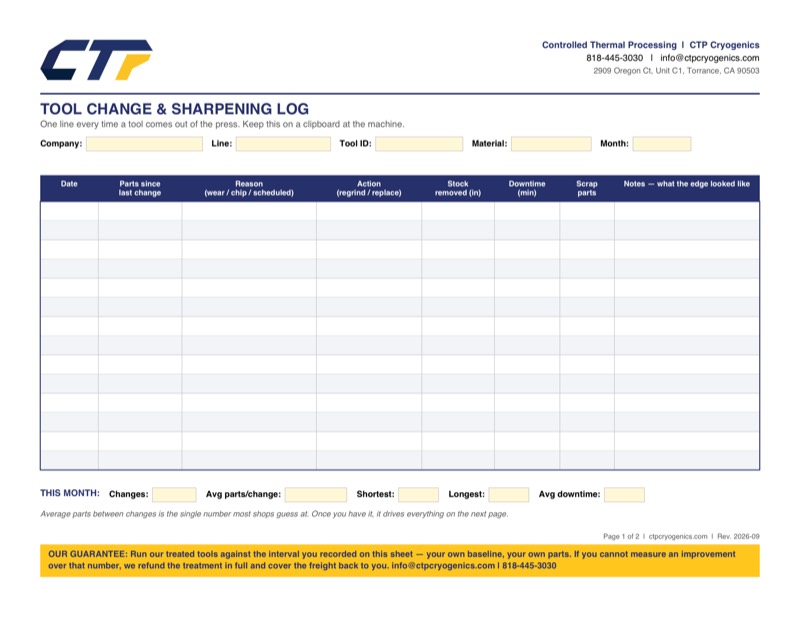
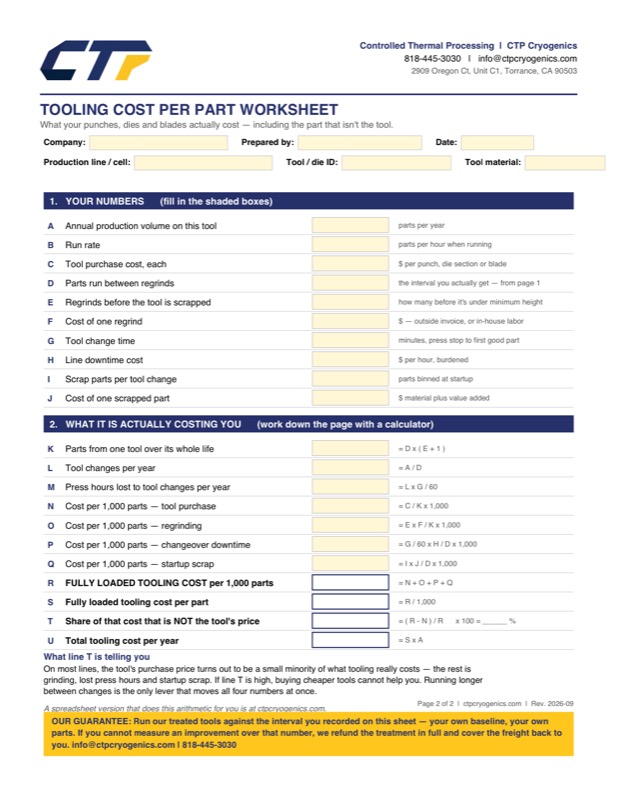
Both pages are in both files.
No macros, no scripts, no external links. The example figures in the sheet are placeholders, not CTP pricing — ask us for pricing on your own parts.
For how to think about what a real cycle includes, see what you are actually buying, and for the rarest evidence of all — a customer who adopted the process, dropped it, and measured what happened — does cryogenic treatment save money.
The Whole Record
Customers ran these tests themselves, on their own parts, and wrote to tell us what they found. The range runs from under one and a half times to ten times, and the spread is the honest part — it depends on the alloy, the prior heat treat, and what was failing in the first place.
Read the letters, 1984–2008 · All case studies · Air Liquide
Industrial is one of several sections: automotive and transportation, marine, electronics, musical instruments and audio.
Send One Part and Count
Pick the component that costs you the most downtime. Record what it does now — parts between changes, what the edge looks like when it comes out. Send us a set, run them the same way, and measure the result yourself.
If you cannot measure an improvement over your own baseline, we refund the treatment in full and cover the freight back to you.